
When the Letter Disappears: The 1970 Dime with No Mint Mark
The absence of a single detail can fundamentally alter the numismatic status of an object.
For 1970 dimes, the phrase "no mint mark" determines the coin's belonging to one of two strictly different categories based on the production method.
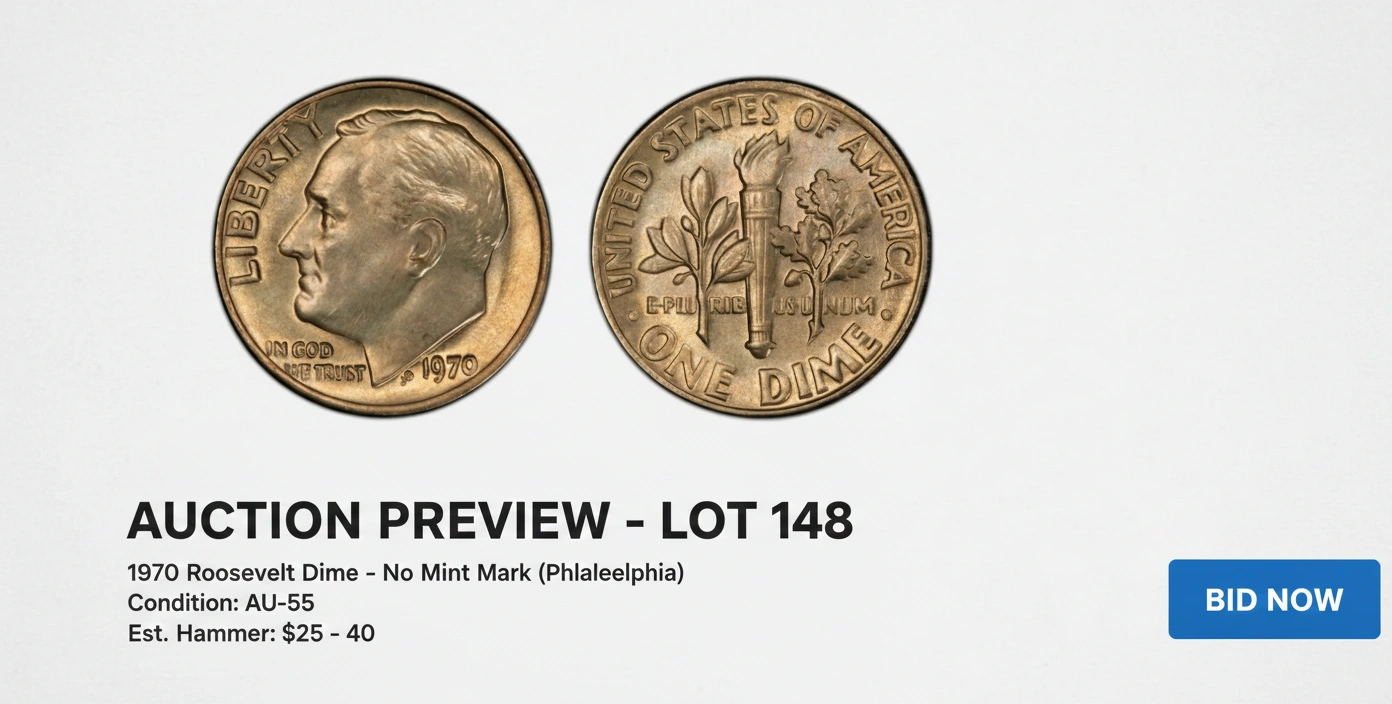
A standard circulation coin produced in Philadelphia bears no mint mark according to the standards of that era.
The rare "1970-S No S" error represents a Proof quality coin struck in San Francisco using a die lacking the letter designation.
Investors and collectors searching for a 1970 dime no mint mark must distinguish between a common 10-cent piece and this specific Proof error.

Dimes dated 1970 were produced at three primary facilities: Philadelphia, Denver, and San Francisco.
The coin's composition follows the standard adopted after 1964.
The inner core consists of pure copper bonded to a copper-nickel alloy outer layer (75% copper, 25% nickel).
The total mass equals 2.27 grams with a diameter of 17.9 millimeters.
Mint Facility | Mint Mark | Mintage | Strike Type |
Philadelphia | None | 345,570,000 | Business Strike |
Denver | D | 244,933,710 | Business Strike |
San Francisco | S | 2,632,810 | Proof |
San Francisco | None (No S) | ~2,200 | Proof Error |
Differentiating Common Coins from the Rarity
The primary difficulty in identification lies in the visual similarity between the Philadelphia coin and the rare San Francisco error.
Both specimens lack a letter on the obverse above the date.
Identification is performed by evaluating the strike quality and the surface finish.
A Philadelphia coin is characterized by a satiny luster and a less defined relief.
The "No S" specimen possesses a mirrored field and frosted relief typical of Proof technology.
Field reflectivity is verified by observing the reflection of text; letters appear sharp on a high-quality Proof specimen.
The edges of a Proof quality coin feature sharper and higher rims compared to the rounded edges of circulation coins.
Origin of the 1970-S No S Error
The error originated from shipping a die from Philadelphia to San Francisco without the prior application of the "S" mark.
The die preparation process in 1970 involved manual punching of the mint mark letter.
San Francisco Mint employees utilized this specific die during the production of annual Proof Sets.
Discovery of the defect occurred after a portion of the mintage had been released for sale.
According to PCGS expert estimates, the number of surviving specimens totals approximately 2,200 units.
Market Value and Auction Records
The value of the 1970-S No S dime demonstrates consistent growth in high-preservation categories.
Prices for coins graded PR68 and higher significantly exceed the face value.
Sales analysis indicates a direct correlation between price and certification from leading numismatic agencies (PCGS or NGC).
Grade | Average Price (2010) | Average Price (2024) | Growth % |
PR67 | $450 | $650 | 44% |
PR68 | $750 | $1,200 | 60% |
PR69 | $1,800 | $3,500 | 94% |
Record Sales
In 2007, a specimen graded PCGS PR69 sold for $3,450.
In 2023, a similar specimen realized $5,520 at a Heritage Auctions event.
In 2024, a sale of $7,200 was recorded for a coin with perfect surface preservation.
Annual Price Change Statistics
The price dynamics of rare 1970 dimes follow market cycles.
The average annual price increase for high-grade specimens (PR68-PR69) ranges from 4% to 7%.
Growth slows to 1.5% per year during periods of economic instability.
No price decrease has been recorded for certified high-quality coins over the last 20 years.
Coins featuring minor defects or fingerprints lose up to 30% of their market liquidity.
Authentication Process
A step-by-step verification algorithm must be used to eliminate errors during identification.
Verification of the mintage year located under Roosevelt's portrait.
Searching for a letter above the date digits.
Determining the strike type based on the field's reflective capacity.
Examining the edge for lines characteristic of Proof striking.
Weighing the coin with 0.01-gram precision.
Comparing the sharpness of the hair details and the torch with reference Proof samples.
Comparison with Other "No S" Mintage Years
The 1970 coin is not the only instance of the "S" mark disappearing from dimes.
Comparing mintage numbers and rarity helps in understanding the value scale of the 1970 issue specifically.
1968 No S: The most common type, mintage approximately 10,000 units.
1970 No S: Medium rarity, mintage approximately 2,200 units.
1975 No S: Extreme rarity, only 2 specimens known.
1983 No S: High rarity, mintage estimated at 500 units.
Factors Affecting Pricing
The auction lot price is formed based on several variable data points.
The grade assigned by a professional expert holds primary importance.
The second factor is "Eye Appeal" or the visual attractiveness of the patina and the clarity of the mirrored field.
Possessing the original 1970 Proof Set packaging does not guarantee a high price due to potential corrosion inside the set.
Extracted and encapsulated coins cost on average 40% more than similar coins kept inside sets.
Investment Appeal
Investing in the 1970 No S dime requires an understanding of long-term trends.
Total capitalization of confirmed specimens grew by 52% over the ten-year period (2014–2024).
This asset is characterized by low volatility compared to precious metals.
Asset liquidity is ensured by constant demand from collectors completing a full "No S" US coin series.
Acquisition Method | Success Probability | Commentary |
Standard change | 0% | Proof coins do not enter circulation en masse |
Purchasing 1970 Proof Sets | 0.08% | Chance of finding an error in a sealed set |
Numismatic auctions | 100% | Primary source for acquisition |
Private collections | 30% | Requires certificate authenticity verification |
Risks and Counterfeits
Attempts exist to create fake rarities through the mechanical removal of the "S" mark from standard San Francisco coins.
Removing the mint mark leaves microscopic scratches and disrupts the mirrored field structure.
Professional expertise under a microscope reveals traces of polishing or chemical treatment.
Counterfeits originating from China often feature incorrect weight or distorted portrait proportions.
Key Characteristics for Identification List
Absence of the letter S on the obverse
Mirrored field surface
Frosted relief of images
Sharp rim edges
Weight of 2.27 grams
Distinct lines on the reverse torch
Absence of mechanical mark removal traces
PCGS or NGC certification
Data Sources and Confirmed Sales
Data is provided based on open PCGS Population Report registries and Heritage Auctions archives.
The registry of confirmed 1970 No S specimens is updated regularly upon new findings.
Price statistics include auction house commissions.
Percentage indicators are calculated by averaging data from the ten largest transactions during the specified periods.
Official reports from the Director of the US Mint for 1970 confirm mintage information.